|
SubtleTea.com |
|
"Believers In Hellholes" - unfinished and ongoing notes on theodicy compiled and commented on by David Herrle |
| These are incomplete and ongoing notes that relate to the problem of evil, why "bad things happen to good/innocent people," and the understandable despair that comes with facing an apparently abysmal universe. |
© 2009 - 2011 David Herrle
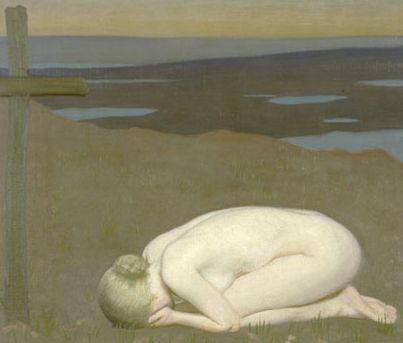
from Youth Mourning by Sir George Clausen
|
"My head aches and I am sad." - Ivan Karamazov
"Alas for human destiny! Man's happiest hours/Are pictures drawn in shadow. Then ill fortune comes,/And with two strokes the wet sponge wipes the drawing out." - Cassandra in Aeschylus' Agamemnon
"So
far gone am I in the dark side of the earth, that its other side, the
theoretic bright one, seems but uncertain twilight to me.
"Either a hero, or mud; there was no middle." - Notes From the Underground
"We go from hope to despair, from optimism to pessimism, from belief to cynicism, from meaning to absurdity, from abundant living to inner bankruptcy." - Rolf Gompertz, Sparks of Spirit
"If there were nothing eternal in man, he could not despair at all." - Kierkegaard
"And why does it make you sad to see how everything hangs by such thin and whimsical threads? Because you're a dreamer, an incredible dreamer, with a tiny spark hidden somewhere inside you which cannot die, which even you cannot kill or quench and which tortures you horribly because all the odds are against its continual burning. In the midst of the foulest decay and putrid savagery, this spark speaks to you of beauty, of human warmth and kindness, of goodness, of greatness, of heroism, of martyrdom, and it speaks to you of love." - Eldridge Cleaver, "Soul On Ice"
- William Rowe argues against the eventual "outweighing good" of lots of suffering. He stresses that the prevention of certain suffering by an all-powerful, good god wouldn't necessarily spoil an "outweighing good." He then posits that suffering would be prevented by this all-powerful god by all means, unless it threatened the "outweighing good." Rowe's conclusion: There is no all-powerful, good god. Rowe uses the pointless suffering of a fawn in agony as an example: a fawn is scorched by a lightning-induced forest fire and suffers for days. Why? What higher purpose does that random misery serve? Why couldn't that, of all things, be prevented without causing some ripple effect against some greater good?
- "There are no atheists in fox holes," but there are despairing believers in hellholes. Pollyannas weep blood in their private lairs. Frank Kermode writes: "Tragedy may make us consider that which we, out of the habit of seeking comfort in the world, avert our eyes from; it legitimates death and pain." Is it all a train that never arrives - or are we on the train and don't realize, tricked by murky windows? I fume at theodicy and how it's so commonly ignored or blah-blahed away. The golden preachers at glass pulpits in ivory megachurches gloss over the problematic "teleological suspension of the ethical" (Kierkegaard's term) in Abraham's near-sacrifice of his son. What of the wretched and sadistic trials of faithful Job (which involved an elitist bet between God and Satan)? Why are little children raped and buried alive? Why deformities and disease? Why war? Why the Rwanda genocide? Why cancer, why tsunamis? [Update: Why the Haiti earthquake?]
- Zizek addresses this in his brilliant two-part essay, "Only a Suffering God Can Save Us" (which focuses on Hegel and Kierkegaard): "Every theologian sooner or later faces the problem of how to reconcile the existence of God with the fact of shoah or similar excessive evil: how are we to reconcile the existence of an omnipotent and good God with the terrifying suffering of millions of innocents, like children killed in the gas chambers?"
- "What makes people rebel against suffering is not really suffering itself," wrote Nietzsche, "but the senselessness of suffering." (And he made the mind-reeling, hard-to-face observation that "to behold suffering gives pleasure" and "to cause another to suffer affords an even greater pleasure.")
- Kierkegaard's study of Job and adversity is a must-read for those contemplating our precarious existential condition: “For who does not understand that when the sea rages wildly and rises up toward the heavens, human beings and their feeble dwellings are tossed about like a toy? Who does not understand that when the storm breaks out and rages, human undertakings are like childish things; or that when the earth quakes with elemental anxiety and the mountains sigh, human beings and their glorious undertakings are as nothing in the abyss?"
- How to explain human brutality? Ed Gein, Jack the Ripper, filicide? What about the butchering of Sharon Tate and her friends, of the LaBiancas? Tate's unborn child died about twenty minutes after she died from multiple stab wounds. What demon inspires such savagery? According to Helter Skelter by Vincent Bugliosi with Curt Gentry, Voytek Frykowski was shot twice, beaten on the head 13 times with a blunt object, and stabbed 51 times. Abigail Folger was stabbed 28 times. Jay Sebring was stabbed 7 times, shot once – bled to death. Sharon was stabbed 16 times in the chest and back.
- Macbeth: “Blood hath been shed ere now. It will have blood; they say, blood will have blood.”
Baudelaire wrote in "Further Notes on Edgar Poe": "This primitive, irresistible force is man’s natural Perversity, which makes him forever and at once both homicide and suicide, murderer and hangman.”
- Admiral Kurtz in Francis Ford Coppola’s Apocalypse Now: “I remember when I was with Special Forces. Seems a thousand centuries ago. We went into a camp to inoculate the children. We left the camp after we had inoculated the children for Polio, and this old man came running after us and he was crying. He couldn't see. We went back there and they had come and hacked off every inoculated arm. There they were in a pile. A pile of little arms. And I remember...I...I...I cried. I wept like some grandmother. I wanted to tear my teeth out. I didn't know what I wanted to do. And I want to remember it. I never want to forget it. I never want to forget."
After listing the many atrocities and punishments that humankind visits upon itself, Erasmus admits how futile it is to figure it out: "I’m got into as endless a work as numbering the sands – for what offenses mankind have deserved these things, or what angry god compelled them to be born into such miseries is not my present business.”
- Nikolai Berdyaev, my favorite philosopher, wrote: "The war but manifests forth the evil, it thrusts it outwards. The external fact of the physical violence and the physical killing is impossible to look at, independently of the evil, as the source of the evil. The spiritual violence and the spiritual killing lie deeper. And the capacity for spiritual violence is very subtle and grasped but with difficulty."
- Consider the criticism of Zeus in "Timon the Misanthrope" by satirist/humorist Lucian, who I call the Lenny Bruce of the 2nd Century. Timon addresses Zues' shortcomings:
You don't hear the perjurers, you don't spot the wrongdoers, you have short-sight and cataracts as far as what goes on is concerned and your ears are as deaf as those of the aged...
...When are you going to stop letting these crimes so carelessly alone, O wondrous one?...[S]hake off this deep, sweet sleep of yours...please show some anger worthy of the young and manly Zeus - unless of course the Cretans are right when they say that you're dead and buried on their island.
This reminds me of "Dear God," a song of atheist despair by the band XTC:
...all the people that
you made in your image, see
...You're always
- As Northrop Frye wrote, the divergence between reality and wish is tragic: “The basis of irony is the independence of the way things are from the way we want them to be; in tragedy a heroic effort against this independence is made and fails.”
- In Elie Wiesel's Night, Moshe the Beadle says, "Man questions God and God answers. But we don't understand his answers." How shriveled and insulting such a statement is when we look into the face of atrocity, or are bitten by it.
Later, while growing accustomed to the indignities and horrors of the death camp, the narrator echoes Wiesel's spiritual trauma: "Never shall I forget those flames which consumed my faith forever...Never shall I forget those moments which murdered my God and my soul and turned my dreams to dust."
"Where is God? Where is He?" someone behind him while being forced to watch inmates hang. A voice within the narrator says, "Where is He? Here He is - He is hanging here on this gallows..." "I no longer accepted God's silence...In the depths of my heart, I felt a great void."
- Tore in Ingmar Bergman's The Virgin Spring prays to god after killing the scum who brutally raped and killed his innocent daughter: "You saw it. God, you saw it.
- Doubting God because of bloody, unfair evidence is far from preposterous. In fact, it's a strongly moral indignation. And despair easily happens. As Chesterton asked, did it not happen to Christ on the crucifix? He claims that "God was forsaken of God" and cried the righteously angry atheists' cry. Christ was "the only one divinity who ever uttered their isolation" and Christianity is the "only one religion in which God for an instant [was] an atheist".
Zizek also cites the Chesterton bit on Christ's momentary atheism. And he poses the weird concept of God seeing Himself through Himself as a debased being: "God himself, the universal Substance, has to 'humiliate' himself, to fall into its own creation, to 'objectivize' himself, to appear as a singular miserable human individual in all its abjection, i.e., abandoned by God. The distance of man from God is thus the distance of God from Himself." The "sublation" of the separating gap between God and Mankind is "in the most tense moment of crucifixion when Christ himself despairs ('Father, why have you forsaken me?'): in this moment, the gap that separates god from man is transposed into god himself, as the gap that separates Christ from God-Father..."
Auschwitz survivor Elie Wiesel wrote in All Rivers Run to the Sea: "I have risen against [God's] injustice, protested his silence and sometimes his absence, but my anger rises up within the faith and not outside it." "I can feel nothing but compassion for those who sincerely lament their doubt," wrote Pascal, "who regard it as the ultimate misfortune."
"The race of life becomes a hopeless flight," Byron writes in Manfred, "[t]o those who walk in darkness." And Swedenborg rejects "those debasing shadows, or material clouds, which darken the sacred temple of the mind."
- Harold Bloom, 1989: "The problems of theodicy, of how to bring together the Talmudical vision of God with the actual fate of the Jews in the twentieth century, seemed to me insoluble whereas a Gnostic perception of God and of religion more than adequately accounts for the dominion of evil. It’s a vexed subject."
- Kobayashi Issa:
In this
world
- Lawrence L. Langer: “[T]he Holocaust still mocks the idea of civilization and threatens our sense of ourselves as spiritual creatures.”
- From Galt's account on the famous discussion about Christianity between Lord Byron and Dr. Kennedy: "His Lordship then said, that one of the greatest difficulties he had met with was the existence of so much pure and unmixed evil in the world, and which he could not reconcile to the idea of a benevolent Creator..."
...His Lordship then asked, if the doctor thought that there had been fewer wars and persecutions, and less slaughter and misery, in the world since the introduction of Christianity than before?"
The answer is no, needless to say. Theocratic Christianity and its mass-mind offshoots have certainly complemented the non-stop, historical spilling of blood.
- Philosopher and theologian John Hick wrote: "Antitheistic writers...assume that the purpose of a loving God must be to create a hedonistic paradise; and therefore to the extent that the world is other than this, it proves to them that God is either not loving enough or not powerful enough to create such a world." Our disappointment or fear causes us to wish for another world, imagined via our innate knowledge of a higher meaning:
Ah, Love! could thou and I with Fate conspire to grasp this sorry Scheme of Things entire, Would not we shatter it to bits - and then Re-mould it nearer to the Heart's Desire!
- Omar Khayyam's Rubaiyat
- Quentin Tarantino's Inglourious Basterds delivers Jewish/Gentile wish-fulfillment by rewriting history: the top brass of the National Socialist Party gunned down and immolated, which ends the war earlier.
- It's like the universe is saying "Fuck you" to us sometimes. And we become outraged at its audacity. How can this unthinking thing repel our loftiest intentions, our sound plans, our greatest pledges? The unfairness, randomness, and danger offends us with its disregard for the helpless and innocent, friend or foe. As Augustine of Hippo put it, "How explain this absurdity?" How do we prepare the children for it? How do we justify it without sounding like utter madmen? How dare the universe insult us so! I can't help but think of a passage from The Catcher in the Rye. Obscene graffiti on a school wall angers Holden Caufield to near-madness: "Somebody'd written 'Fuck you' on the wall. It drove me damn near crazy...I kept wanting to kill whoever'd written it."
- In A Grief Observed, C.S. Lewis stumbled through an abyss of doubt and despair after the death of his wife, warning: "[D]on't come talking to me about the consolations of religion or I shall suspect that you don't understand." And: "[G]o to Him when your need is desperate, when all other help is vain, and what do you find? A door slammed in your face...After that, silence...Will there come a time when I no longer ask why the world is like a mean street, because I shall take the squalor as normal?" Chesterton wrote that atheism "is the reversal of a subconscious assumption in the soul; the sense that there is meaning and a direction in the world it sees...the sense of impotence and despair with which men shook their fists vainly at the stars, as they saw all the best work of humanity sinking slowly and helplessly into a swamp...To men in that mood there was a reason for atheism that is in some sense reasonable." As the Chorus puts it in Euripides' Helen:
What is god, what is not god, what lies between man and god? Who on this earth, after searching, can claim to have been to the end of that question's tortuous lane? For every man has seen the plans of the gods lurching here and there and back again in unexpected and absurd vicissitudes...
- "Nothing can shake my belief that this world is the fruit of a dark god whose shadow I extend," wrote Emil Cioran in The New Gods.
Sol Hadden in Carl Sagan's wonderful novel, Contact: "If God didn't want Lot's wife to look back, why didn't he make her obedient, so she'd do what her husband told her? Or if he hadn't made Lot such a shithead, maybe she would've listened to him more. If God is omnipotent and omniscient, why didn't he start the universe out in the first place so it would come out the way he wants? Why's he constantly repairing and complaining? No, there's one thing the Bible makes clear: The biblical God is a sloppy manufacturer. He's not good at design, he's not good at execution. He'd be out of business if there was any competition."
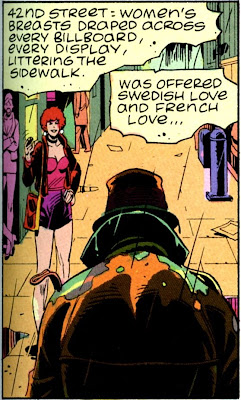
- Rorschach, the lone-wolf hero of Alan Moore's Watchmen (and one of the most heartbreaking and noble comic-book characters ever), thrashes about in almost total despair and nihilism catalyzed by childhood abuse, the world's unfair slings and arrows, and the eventual molestation and slaughter of a little six-year-old girl whose corpse is fed to dogs. His heroism is based on vigilante justice, a kind that's shunned by the pampered, self-righteous public but is the best thing going when law is corrupt and order is illusion. (After all, as Orwell wrote in "Notes On Nationalism," "those who 'abjure' violence can only do so because others are committing violence on their behalf.") He wears a black and white mask of shifting ink blots, fashioned from the remains of the dress of a woman who was raped and killed on a New York City street - unaided by forty witnesses.
- When comics artist/writer Steve Ditko converted to Objectivism, he created Mr. A (after Ayn Rand's adoption of Aristotle's A = A equation): a hero who meted out justice according to a black and white worldview: good versus evil, with zero toleration or mercy for bottom-feeders and criminals. Ditko also modeled The Question in this fashion. Rorschach is a fractured amalgam of these two Randian heroes, apparently created by Alan Moore to be both satirical and sympathetic (similar to Norman Lear's Archie Bunker).
- Andrew Firestone interview with Moore at Salon.com, Moore's thoughts on Rorschach: "Rorschach is the least morally compromised of all the characters. He is also psychotic, which, again, raises an ambiguity to the thing. Maybe the most psychotic character could be the most morally pure and morally directed and maybe the most apparently enlightened character, Ozymandias, could be in the end the most damned and the most appalling."
- Rorschach reminds me of two similar characters, one from film and the other from literature: Travis Bickle, the troubled, fractured-fairy-tale hero of Scorsese's and Paul Shrader's Taxi Driver and the unnamed narrator of Dostoyevsky's Notes From the Underground (or Letters from a Mousehole, take your pick). Not only was Taxi Driver inspired partly by the book, but parallels between all three protagonists abound - down to the voiceover/journal/letter narration.
When Travis' fear and trembling before the sewer of humanity on New York City's streets conflates with his shocked concern for a 12-year-old prostitute, he develops a vigilante-style savior complex that ends up in a dramatic bloodbath. Despite Travis' desire for uprightness and striving for order, he can't live by those standards himself, let alone cure the world of its vices and brutality. Like Rorschach, Travis admires the good so much, loves love so much, that he has died to the good and love, so that he is drowning in the same sewer he wishes to cleanse and hates hate instead of feeling love at all. "There's no escape," says Travis. "I'm God's lonely man." He longs for the life-giving sun, but prefers nighttime death-dealing. Roger Ebert's assessment of Travis Bickle and Scorsese's characters is apt: "[Travis'] ambivalent feelings about sex (he lives in a world of pornography, but the sexual activity he observes in the city fills him with loathing). His hatred for the city, inhabited by 'scum.' His preference for working at night..." "[S]o many of Scorsese's characters...despise themselves, they live in sin, they occupy mean streets, but they want to be forgiven and admired." The sin-loathing parallels the Underground Man: "I hate smut, and I hate people who relish smut...I love truth, sincerity, and honesty."
Notes From the Underground closes with another narrator calling the Underground Man a "paradoxicalist", and Rorschach's private, tortured journal entries are obviously similar. And Underground Man imagines a man who is very similar to Rorschach (down to a weird "physiognomy") who will interrupt the well-oiled cogs of a euclidean utopia that is dirt-free and defanged:
"I would not be in the least surprised to see a certain gentleman get up, out of the blue, in the midst of the general future reign of reason, with an ignoble - or, better, with a retrograde and mocking - physiognomy, and say to us, with his arms akimbo: 'What, my dear sirs, if we should smash all this good sense to smithereens with one hard kick, to the sole end of sending all these logorithms to the devil and living a while again according to our stupid will!'"
- "Ashamed for humanity," Rorschach tells the prison psychiatrist, "[I] made a face that I could bear to look at in the mirror." "I hated my face," writes Underground Man. And Dmitri in The Brothers Karamazov: "[T]here are two heads left...That is, one of the heads is mine, and the other - that monster's. So choose: me or the monster?"
- “God wanna fill my heart, the devil wanna wear my skin…
I'm a walkin' talkin' livin' breathin'
contradiction - Everlast
Underground Man again: "I felt them swarming inside me, those contrary elements."
We are lost. What are we to do? Into the field the devil evidently doth take us, Spinning us round and round every which way. - Pushkin
Cornel West: "I'm a bluesman moving through a blues-soaked America, a blue-soaked world, a planet where catastrophe and celebration...sit side by side."
- Mike Hammer contemplates the nighttime city in Mickey Spillane's Kiss Me, Deadly: "The voice of the monster outside the glass was a constant drone, but when you listened long enough it became a flat, sarcastic sneer that pushed ten million people into bigger and better troubles, and then the sneer was heard for what it was, a derisive laugh that thought blood running from an open wound was funny, and death was the biggest joke of all...
"It was the voice of the guy with the whip who laughed at each stroke to drown out the screams of the victim...I sat and heard it and thought about it while the statistics ran through my head. So many a minute killed by cars, so many injured. So many dead an hour by out-and-out violence. So many this and so many that...
"Then I knew the voice outside for what it was. Not some intangible monster after all. Not some gigantic mechanical contrivance that could act of its own accord. Not a separate living being with its own rules and decrees. Not one of those things.
People, that's all.
Just soft, pulpy people, most of them nice. And some of them filthy and twisted who gorged themselves on flesh and puffed up with the power they had so that when they got stuck they popped like ripe melons and splashed their guys all over the ground."
- Walter A. Davis in Deracination: “Faced with Hiroshima one can, indeed, die of a heartbreak from which there is no recovery. How was it possible for human beings to do this thing? To put it in Kantian terms, what must human beings be like for Hiroshima to be possible?”
- Rorschach relates how he avenged the little girl by burning the molester/murderer alive in a tenement full of scummy people. As Rorschach watched the flames engulf the building, he "looked at sky through smoke heavy with human fat and God was not there. The cold, suffocating dark goes on forever, and we are alone...There is nothing else...It is not God who kills the children. Not fate that butchers them or destiny that feeds them to the dogs. It's us. Only us." Augustine of Hippo concludes that evildoing "is only a sickness of soul," and Rorschach ponders, "Violent lives, ending violently. Something in our personalities perhaps? Some animal urge to fight and struggle, making us what we are?" Walter A. Davis forces us to face our own ugly faces in Deracination: Historicity, Hiroshima, and the Tragic Imperative: "Horror is the eloquent rejoinder to humanistic reassurance about the fundamental goodness of 'human nature.'" "It was exhausting," says Ellison's Invisible Man, "for no matter what scheme I conceived, there was one constant flaw - myself."
As Pascal asked, "What reason for joy can be found in the expectation of nothing but helpless wretchedness?" Joseph Conrad's Kurtz sums up existence as "The horror": "Droll thing life is - that mysterious arrangement of merciless logic for a futile purpose." Marlow, the narrator, notes Kurtz' despaired detachment: "There was nothing either above or below him...He was alone." He suffers a similar, passionate fate as Melville's Ahab.
- Joseph Conrad to R.B. Cunningham Graham, 1897: “There is a – let us say – machine. It evolved itself…out of a chaos of scraps and iron and behold! – it knits. I am horrified at the horrible work and stand appalled. I feel it ought to embroider – but it goes on knitting…[T]he infamous thing has made itself: made itself without thought, without conscience, without foresight, without eyes, without heart…It knits us in and knits us out. It has knitted time, space, pain, death corruption, despair and all the illusions – and nothing matters.”
-
- Rorschach has seen the sinful face of Humanity and seeks to lacerate it again and again. Erich Fromm addresses a "shattering of faith" type of violence in The Heart of Man: "If there is nothing and nobody to believe in, if one's faith in goodness and justice has all been a foolish illusion...then, indeed, life becomes hateful...The disappointed believer and lover of life will be turned into a cynic and a destroyer. This destructiveness is one of despair; disappointment has led to hate of life." "The maze of nature is inextricable, and offers no escape" without higher understanding, Swedenborg says. "Without God," writes Rolf Gompertz, "the universe would be a dead universe."
Rorschach is the wounded consciousness of individual sovereignty drowning in the abstract, muted by a crushing collectivist roar. That flood and noise tend to cancel out the impact of a single death, even a child's. The norm of violence desensitizes the We to the astronomical seriousness of a single snuffed life. Unlike Veidt, the dashing, popular, Wilsonian, demagogic mass reformer of Watchmen, Rorschach would rather obsess over and attempt to save the tattered ends rather than champion the collectivist means and accept the number game of the Greater Good. "Why does one death matter against so many?" he asks. He answers himself in Mr. A fashion: "Because there is good and there is evil, and the evil must be punished. I shall not compromise in this."
Coincidentally, in The Brothers Karamazov, Ivan Karamazov, during a discussion about theodicy with his brother, blurts a long list of examples of the ingenuity of human cruelty, which includes a boy who is torn to pieces by hounds before his own mother's eyes. A spiteful general had arranged the slaughter as punishment for a mistake the boy had made. He goes on to relate a story of sadistic parents - "educated and humane Europeans" - who delighted in torturing their five-year-old daughter: beating her, letting her freeze in an outhouse, then smearing her own shit on her face before forcing her to eat it. Like Rorschach, Ivan has a dying heart and he refuses to compromise with a deity that would damn the innocent. They are both shredded men walking the nasty streets, like Travis Bickle. My sorrow echoes Ivan's sorrow, and my heart is torn to shreds every time I read this:
"Can you understand that a small creature, who cannot even comprehend what is being done to her, in a vile place, in the dark and the cold, beats herself on her stained little chest with her tiny fist and weeps with her anguished, gentle, meek tears for 'dear God' to protect her...can you understand why this nonsense is needed and created?...Who wants to know this damned good and evil at such a price? The whole world of knowledge is not worth that little child to 'dear God''...So people themselves are to blame: they were given paradise, they wanted freedom, and stole fire from heaven, knowing that they would become unhappy...But then there are the children, and what am I going to do with them? That question I cannot resolve...I absolutely renounce all higher harmony. It is not worth one little tear of even that one tormented child who beat her chest with her little fist and prayed to 'dear God' in a stinking outhouse with her unredeemed tears! Not worth it, because her tears remained unredeemed."
- Oh, that little child. The little children. The infectious, thrilling lust for power and blood. "Let there be no torture of children; rise up and preach it at once, at once!" cries Dostoyevsky's Father Zosima. I walk the streets and become ill over it: I suspect everyone, hear the hungry growls of the beasts within, shudder at the glutted morgues and unknown, lonely graves of the smitten. "HOW DOES IT FEEL TO BE FREE OF ILLUSION," Ellison's Invisible Man is asked. He replies, "Painful and empty." In "the Grand Inquisitor," Christ resurrects a little dead girl from a coffin when he returns to earth as a man. Oh, isn't that my desperate dream? Exhausted like Rorschach, like Ivan Karamazov, I almost surrender to a lyric by The Sundays: "So I cynically, cynically say the world is that way."
Why? Because I doubt, because I slide into the valley of death again and again, because I dread the black velvet and the infinite, insensate slumber. And Humanity's creative destructiveness and inventive torture scares me to the blood. To echo Pascal, "Such is my state, full of weakness and uncertainty." There are times when I have zero trust in and hope for the future. Religion fails me again and again, and so-called progressivism strikes me as a sick, sadistic joke, as spittle, as scraps of toilet paper. I trust in Man only to turn itself into clay, into abused means for the good of a soulless State. I expect Man to only tease the dreamers with incidental creations and comforts, then kick their faces in over and over forever. I tend to shun reformers and earthly-bread institutions. I want to spray-paint a mocking Alfred E. Neuman on the cornerstone of a Fourier phalanx, flick my Bic under a Mao poster, and blow my nose on the Kellogg-Briand Pact (which outlawed war early last century). To paraphrase Joseph Conrad, I diverge from H.G. Wells, who hated Humanity but believed it could be improved, but I love Humanity while denying its (self-sustained) improvability.
- Dostoyevsky's "The Grand Inquisitor": The most devastating and foresightful tract in literature. Sorrow chokes my throat; I'm left dizzy and half-dreaming, unable to see the world in its normal, lying light.
- Underground Man: "Why, suffering is the sole root of consciousness."
"It is human to sorrow," says Kierkegaard, "human to sorrow with the sorrowing..."
Sorrow is knowledge: they who know the most Must mourn the deepest o'er the fatal truth...
- from Byron's Manfred
"The value of human life lies not in the happiness but rather in suffering," says Hermann Cohen.
From Psalm 23: "Thy rod and Thy staff they comfort me." Rod refers to suffering.
Psalm 40:12:
For troubles without number surround me;
Terrence Des Pres: “In the literature of survival we find an image of things so grim, so heartbreaking, so starkly unbearable, that inevitably the survivor’s scream begins to be our own.”
- From Faulkner's The Reivers: "No epoch of history nor generation of human beings either ever was or is or will be big enough to hold the un-virtue of any given moment, any more than they could contain all the air of any given moment; all they can do is hope to be as little soiled as possible during their passage through it."
- Consider this passage from As You Like It, by Whoever-Shakespeare-Was:
ROSALIND: They say you are a melancholy
fellow.
JAQUES: I am so; I do love it better than
laughing.
ROSALIND: Those that are in extremity of
either are abominable
JAQUES?: Why, 'tis good to be sad and say
nothing.
ROSALIND: Why then, 'tis good to be a post. JAQUES: [M]y often rumination wraps me in a most humorous sadness.
- "Nobody cares," Watchmen's Rorschach writes in his journal. "Nobody cares but me."
"[T]he knight of faith is alone in everything," writes Kierkegaard (as Johannes de Silentio).
Byron's Manfred:
I have not loved the world, nor the world me; I have not flatter'd its rank breath, nor bow'd To its idolatries a patient knee...I stood Among them, but not of them; in a shroud Of thoughts which were not of their thoughts...
- To oversimplify Ayn Rand, she seems to insist that rational choice and moral fortitude solve the problem of evildoing. She rejects the notion of fundamental human lowliness. To battle savagery, one must be human, choose and strive to be fully human, to reject collective barbarism. Escape is possible here and now. As Anthem's narrator says, "For I know what happiness is possible to me on earth...My happiness is not the means to any end. It is the end. It is its own goal. It is its own purpose." Though her brand is more attractive than and not as destructive as collectivist utopianism, my brows raise at her panacea as well.
- Augustine of Hippo asked a colleague, "What is wrong with us?" He looked to God for the reason for Man's evildoing: "Let your mercy enlighten me so that I might ask whether the answer lies in the mysterious punishment that has come upon men and in some deeply hidden damage in the sons of Adam. Why this absurdity? And how to explain it?"
- However, dear Chesterton hurls light into my mounting blindness: "The center of every man's existence is a dream. Death, disease, insanity are merely material accidents, like a toothache or a twisted ankle. That these brutal forces always besiege and often capture the citadel does not prove that they are the citadel." I run to one of my bookcases, pull out a John Gardner anthology from between Nin and Swedenborg, and flip to a passage I'd underlined for times like this: "A thoroughly dark view of life is the view of a blighted spirit not to be trusted. This is merely to say that a man whose family has died in a house struck by lightning may not be a perfect judge of storms." I turn to Epictetus, who insists praises nature's glory and the human spirit's endurance. I spring from death to life, distrust to hope. I'm reminded of the wonderful contradiction of Mark Twain's insistence that altruism is merely disguised selfishness and his gushing admiration of the "pure" Joan of Arc.
Likewise, Rorschach contradicts his nihilism when he writes: "Answers soon. Nothing is insoluble. Nothing is hopeless. Not while there's life." "Never despair. Never surrender." And Lewis? He sprang from the abyss after his crucible of doubt: "I have gradually been coming to feel that the door is no longer shut and bolted...[God] always knew that my temple was a house of cards. His only way of making me realize the fact was to knock it down." I recall the elation of Euripides' Helen: "For joy the hairs on my head/rise and shiver, for joy I shed/tears..."
- Quoting Deuteronomy 23:6, Rolf Gompertz stresses God's "Law of Transformation" in Sparks of Spirit (page 31): "God turns evil against itself, so that it achieves the opposite of its intentions...Evil produces an opposite thrust to the degree and to the extent of its presence."
- In Reflections On The Psalms, C.S. Lewis refers to the negative passages in Psalms, he writes: "The shadows have indicated...something more about the light." James Baldwin, in his introduction to Blues For Mister Charlie, wrote, "We are walking in terrible darkness here, and this is one man's attempt to bear witness to the reality and the power of light."
- In a desperate desire to help his ailing father survive, the narrator in Elie Wiesel's Night resorts to spiritual deseration: "And, in spite of myself, a prayer rose in my heart, to that God in whom I no longer believed."
- But...the children. What about them? That unresolved question remains. Those unredeemed tears drown and exhaust me all over again. And I remember Helen again, after fate has dashed her spirit: "I'm lost. My hopes are dead, and so am I." I fall into the crucible again and again.
"The house of the wicked will be destroyed, but the tent of the upright will flourish." - Proverbs 14:11
All work is copyrighted property of David Herrle.
|
|
[back to top] [home] |
|
© 2011 SubtleTea Productions All Rights Reserved |